Replacing paper equine passports with a trusted digital standard
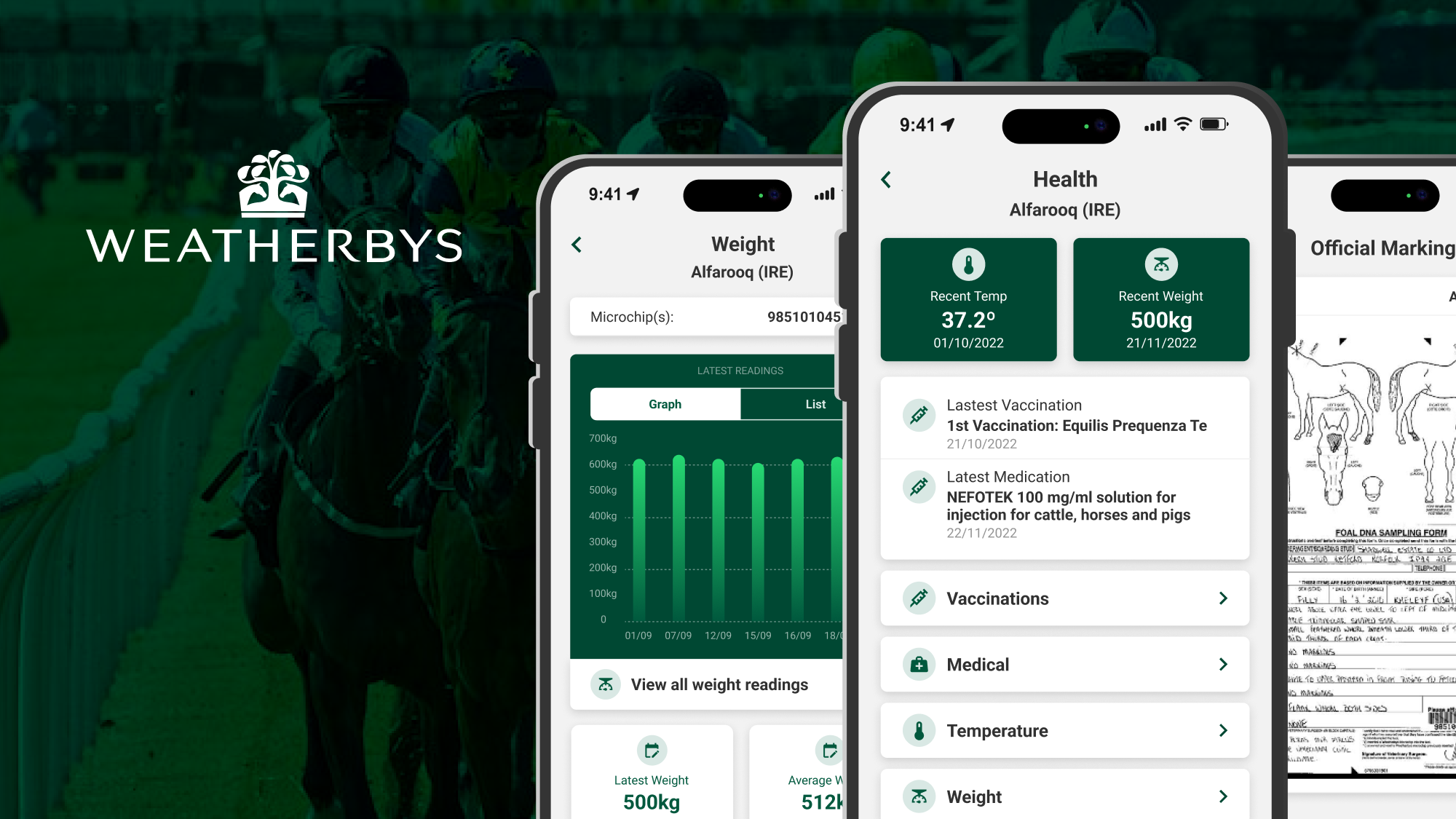
Weatherbys ePassport
Case study UX/UI APP
Client
Weatherbys Ltd
Role
UX/UI and Lead Design
Overview
Weatherbys needed to replace the traditional paper equine passport with a secure digital alternative that could be trusted by owners, breeders and vets across the UK and Ireland.
I led the UX and product design for the mobile and web platform, working closely with product owners and developers to translate complex regulatory requirements into a simple digital workflow.
The result was a system that allows horses to be identified, managed and transferred digitally, reducing reliance on paper documents while improving traceability and compliance.
Context and problem
Weatherbys manages official horse passports and identity records in Great Britain and Ireland. Historically this relied on physical documents, making access slow and impractical in time-sensitive situations.
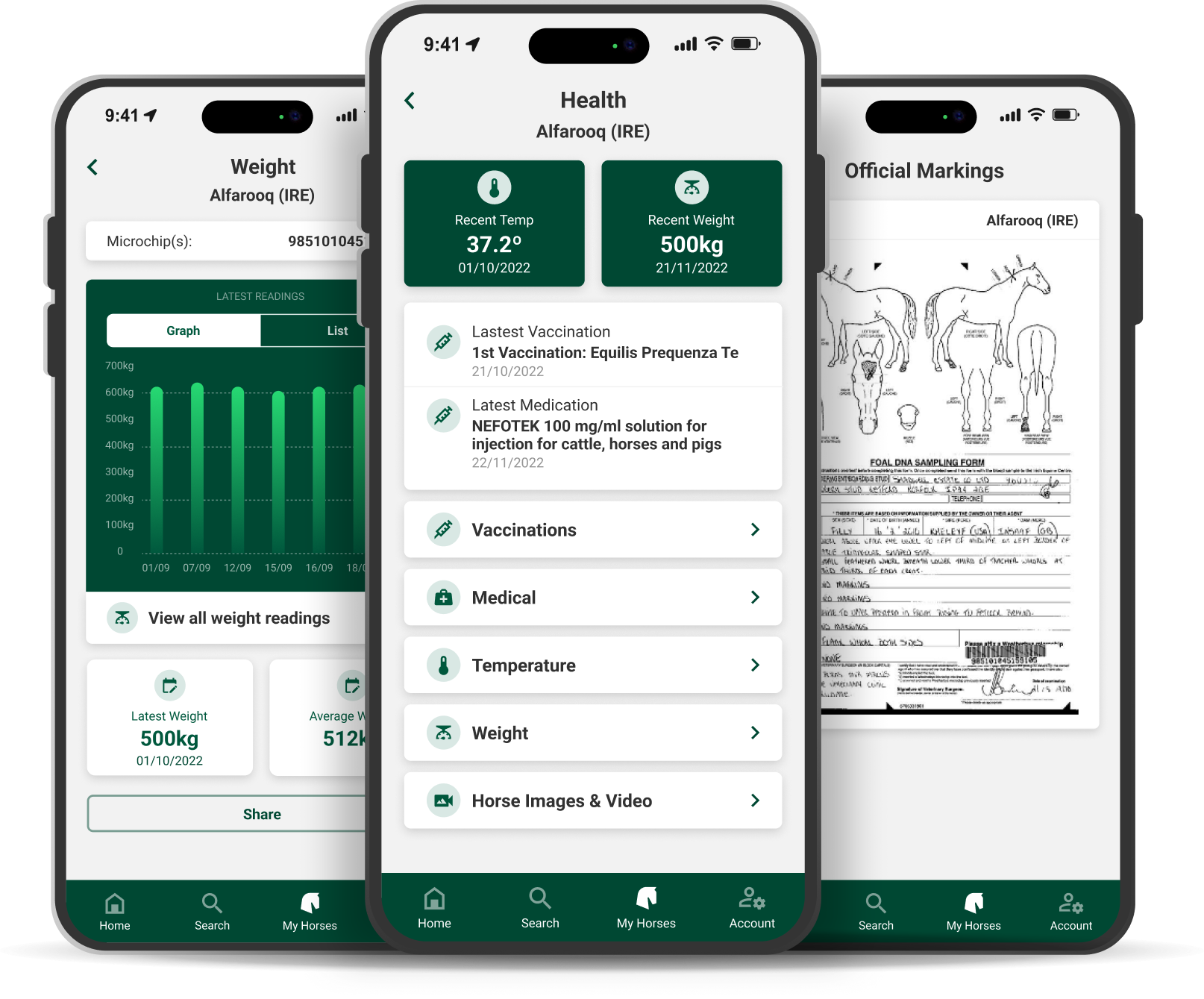
The ePassport app allows users to scan a horse's microchip to access and update digital records, providing a secure, 24/7 mobile alternative to paper passports covering identification, vaccinations, ownership, and movements.
The challenge
Replace a trusted paper process with a digital experience that felt reliable, clear, and usable within a regulated environment.
Goals
1
Provide fast, reliable access to official horse records
2
Maintain trust and regulatory confidence during the transition from paper to digital
3
Support different user groups with varying technical confidence
4
Replicate the outcomes of the paper process in a clearer, more reliable way
Research and insights
Research focused on understanding how the paper passport process worked and where it caused friction.
I worked closely with Weatherbys administrative staff to understand how horse records were created, checked, and validated. Workshops mapped the paper process end-to-end, identifying pain points and informing core user journeys.
Core user groups:
Racehorse trainers
Yard staff
Horse owners
Vets
Key insights:
Users needed fast access to information under time pressure
Trust in record accuracy mattered more than additional features
Mirroring the paper passport structure helped users accept the digital version
The app would be used in rural locations with poor connectivity
A single, clear source of truth was preferred over complex navigation
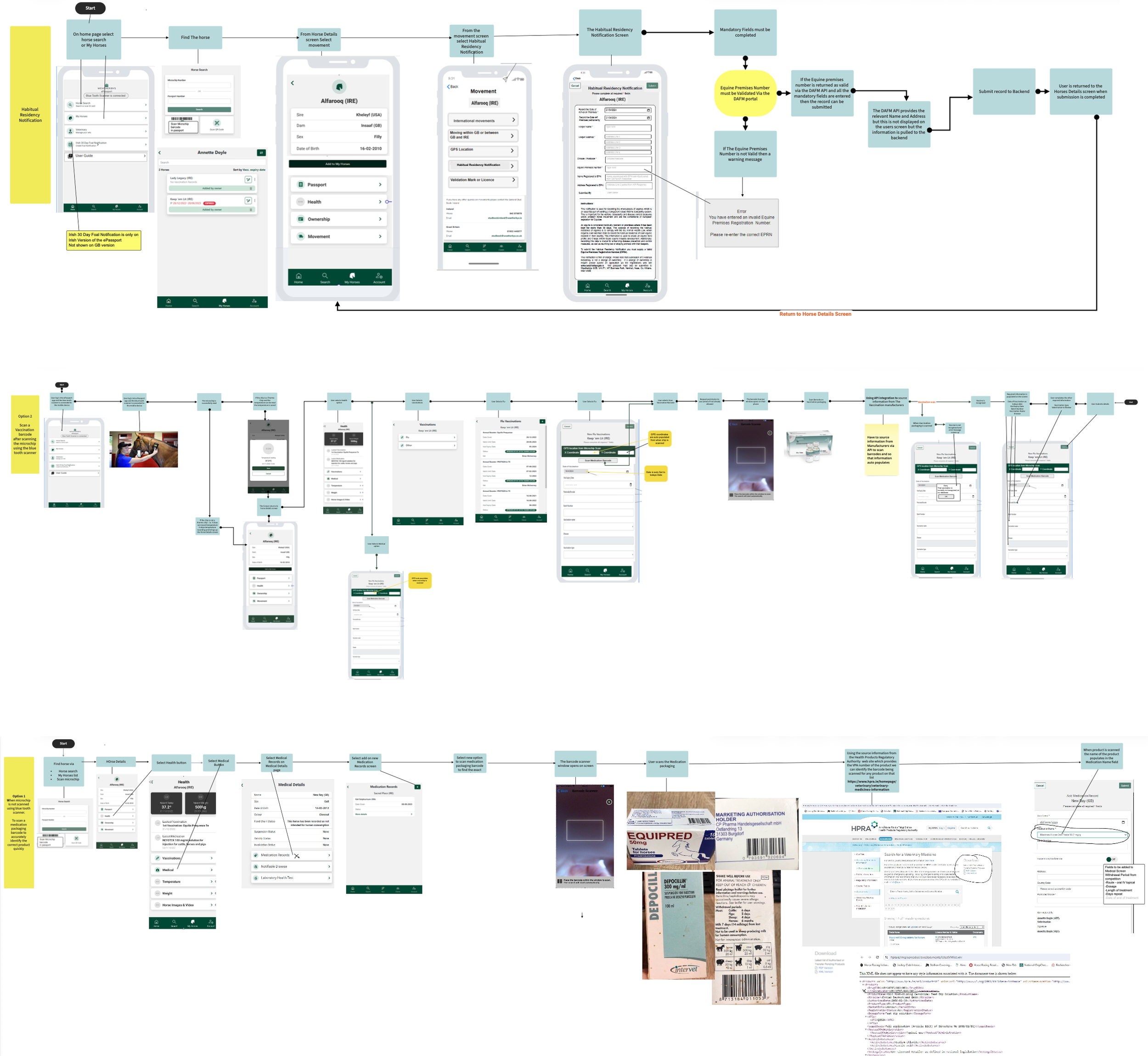
Some examples of the user journeys identified through research:
User journeys: Sample flows from workshops
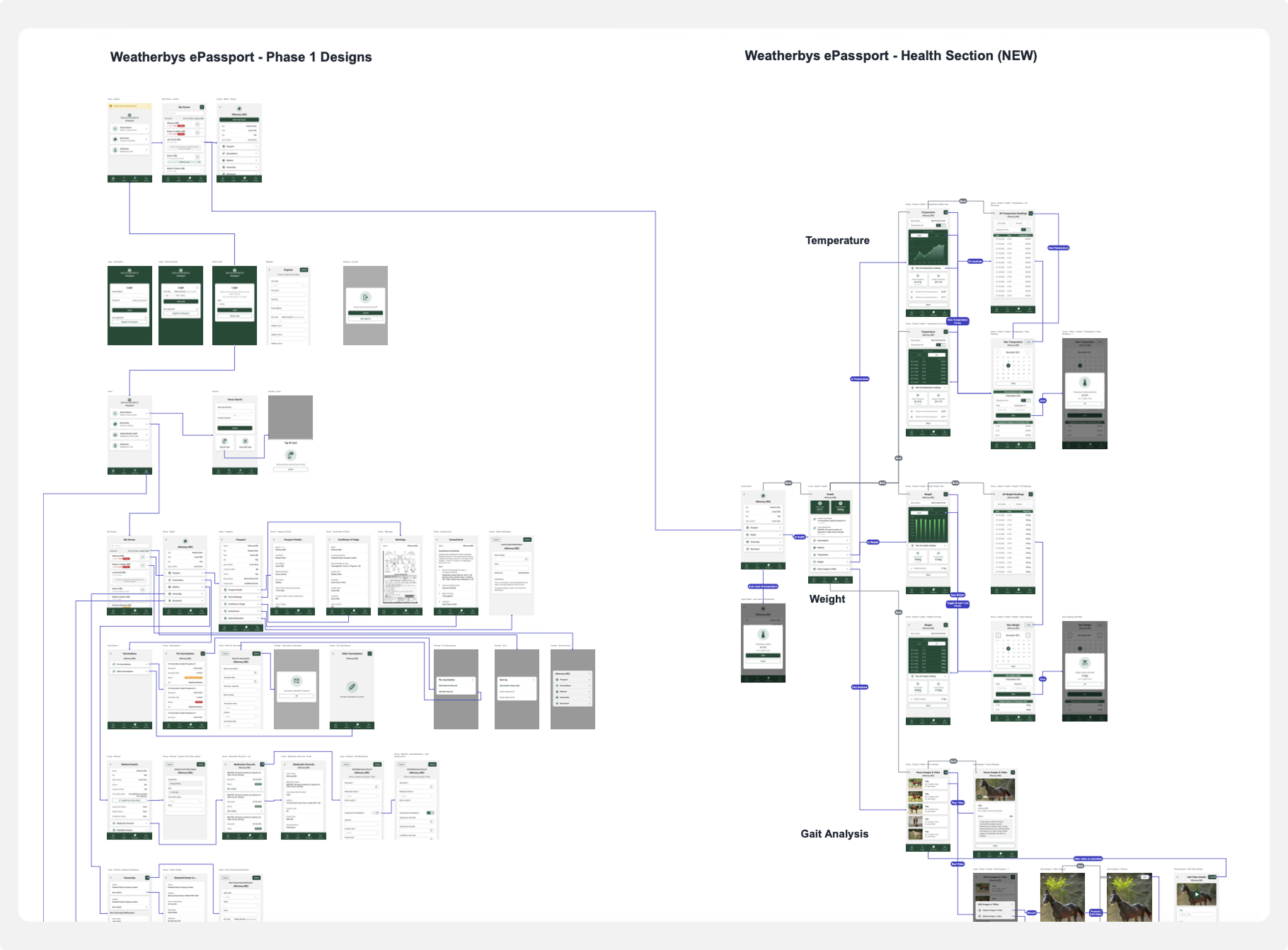
End to end app flow: Partial view showing how the main journeys connect across the product
Key decisions and business alignment
The focus was to keep what worked in the paper process and make it usable on mobile.
Key decisions I made included:
Making microchip scanning the primary entry point into the app
Structuring information to closely mirror the layout and logic of the paper passport
Surfacing validation and status information early to reduce uncertainty
Keeping flows short, predictable and easy to complete in real world conditions
Prioritising accessibility and legibility throughout, particularly for use in yards and on racecourses
Design work
Design work focused on clarity, trust and real-world usability, rather than introducing new behaviour for the sake of it. The aim was to make the digital experience feel familiar, reliable and appropriate for regulated use.
What I delivered:
User journeys and screen flows aligned to the existing paper process
Wireframes to validate structure, information hierarchy and flow
Interactive prototypes used to test and refine key journeys
Final UI designs optimised for mobile use in outdoor environments
Ongoing iteration based on stakeholder feedback and validation
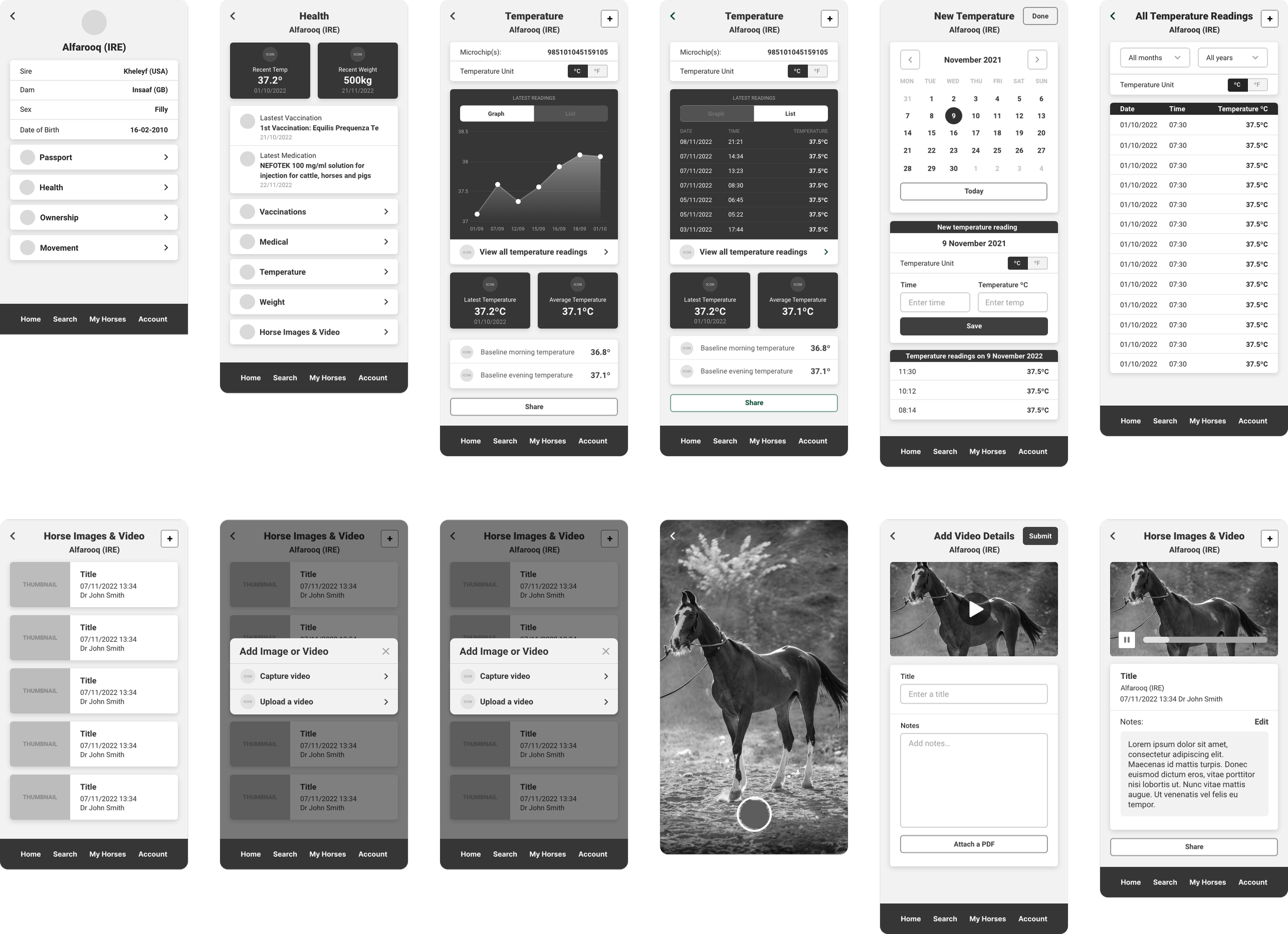
Wireframes
Examples of wireframes used to explore key journeys.
These were kept at medium fidelity to focus on structure and flow without getting distracted by visual detail.
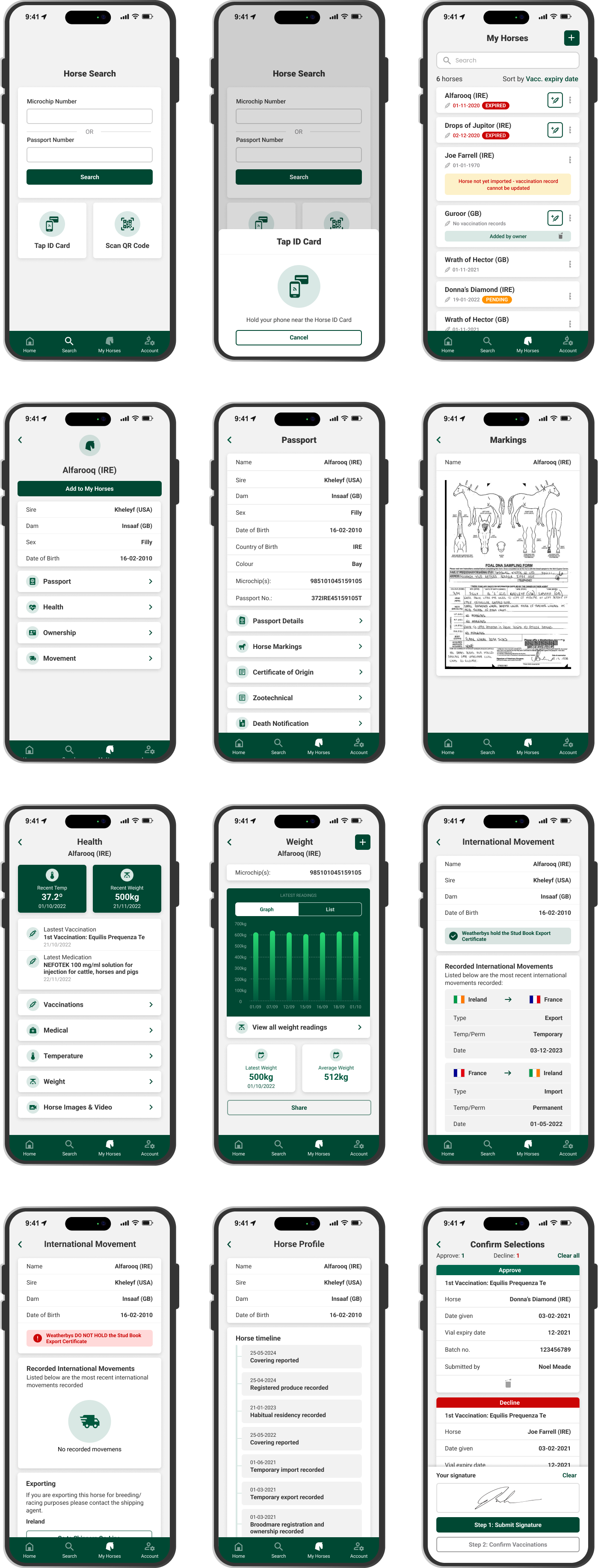
UI designs
Examples of the final UI designs from across the product.
Outcomes and learnings
1
Fast access to official horse records
Users can quickly access verified horse identity and vaccination records, supporting over 5,000 users across the UK and Ireland.
2
Improved compliance and biosecurity checks
Clear, easy to read health and vaccination information helped support compliance across racing, transport, and events.
3
Reduced reliance on paperwork and manual checks
Moving away from physical documents reduced duplication, delays and the risk of outdated information being used.
4
Simpler admin for all user groups
Trainers, owners, vets and Weatherbys staff spent less time managing records and more time getting on with their day.
5
Designed for real world, time critical use
The app works in yards, racecourses and checkpoints where decisions need to be made quickly and with confidence.
6
Recognised digital system for Thoroughbred ID in the UK and Ireland
Adopted by the industry as the official mobile alternative to paper passports.
Learnings
This project reminded me that in regulated environments, clarity is not a nice to have. It is the product. I learned the value of working closely with vets, regulators and industry experts early, to uncover real world scenarios and edge cases that would otherwise be missed.
Keeping the interface simple and familiar helped reduce friction and made onboarding easier for a wide range of users, many of whom were not used to digital tools.
More work
-
![Travis Perkins Price Hub]()
Travis Perkins Price Hub
CASE STUDY UX/UI ENTERPRISE
-
![]()
Ucando-it Employee Wellbeing
CASE STUDY UX/UI APP WEB
-
![]()
Wetherspoon Order & Pay
UX/UI APP
-
![MyJDW App]()
MyJDW App
UI APP
-
![House of Garrard]()
House of Garrard
UX/UI eCOMMERCE
-
![Wetherspoon Allergen Kiosk]()
Wetherspoon Allergen Kiosk
UX/UI KIOSK
-
![Inside Out Community]()
Inside Out Community
UX/UI WEB
-
![D&AD Community Portal]()
D&AD Community Portal
UI WEB
-
![Medivet Careers]()
Medivet Careers
UI WEB
-
![Crystal Palace FC Members]()
Crystal Palace FC Members
UX/UI WEB
-
![Weatherbys ePassport]()
Weatherbys ePassport
CASE STUDY UX / UI APP